
“Should I choose a private hospital or a government hospital for my delivery?”
You may start with a simple question: “Which maternity hospital is best in Palam?”
Then you discover that there are government hospitals, private hospitals, nursing homes and multispecialty hospitals, all offering different services and prices.
The honest answer is that neither option is automatically better for everyone.
For one family, affordability may be the biggest concern. Another family may place more importance on privacy, convenience or staying with a particular obstetrician. If the pregnancy is considered high-risk, the hospital’s medical and emergency capabilities may become the most important consideration of all.
Instead of asking which type of hospital is universally better, it makes more sense to ask:
“Which hospital is appropriate for my pregnancy, my budget and my family’s needs?”
Let’s look at the differences.
Private vs Government Maternity Hospitals: A Quick Comparison
| Factor | Private Hospital | Government Hospital |
| Cost | Usually, higher | Often lower or subsidized |
| Room choices | Often several options | Usually more limited |
| Privacy | Often greater | Depends on facility |
| Waiting time | May be shorter | Can be longer depending on patient load |
| Doctor choice | Often more flexibility | Depends on the hospital system |
| Facilities | Vary between hospitals | Vary between hospitals |
| Emergency care | Depends on the facility | Depends on the facility |
| Patient volume | Varies | May be relatively high |
These are general patterns, not rules. A particular government hospital may have excellent facilities, while a particular private hospital may have limitations.
That’s why the individual hospital matters more than the label.
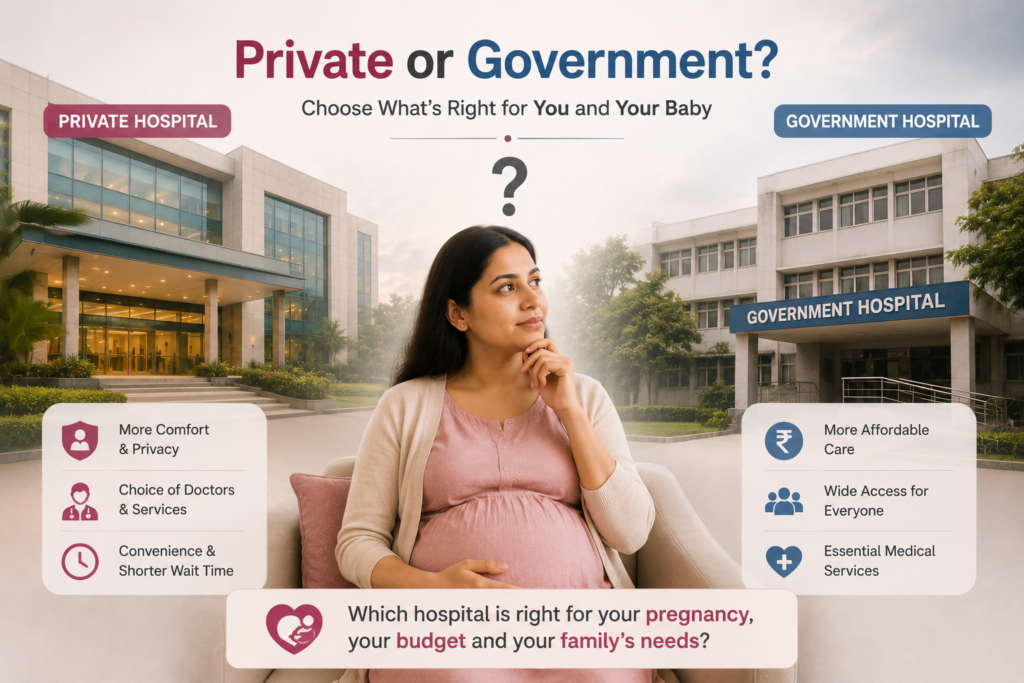
Cost Is Often the First Difference Families Notice
There’s no getting around it: cost can be a major consideration when planning a delivery and choosing a Maternity Hospital.
Government hospitals may offer maternity care at a lower out-of-pocket cost or through applicable public healthcare programs.
Private hospitals usually have more varied pricing.
The final bill can depend on:
- Type of delivery
- Room category
- Doctor fees
- Medicines
- Investigations
- Length of stay
- Baby-care requirements
- Additional procedures
- Any complications that arise
One mistake family sometimes make is looking only at the headline “normal delivery package.”
Ask what the package actually includes.
For example:
Are doctor charges included? What about medicines? Investigations? Baby-care charges? Additional nights?
A slightly more expensive package with clearer inclusions may sometimes be easier to plan for than a cheaper-looking package with many exclusions.
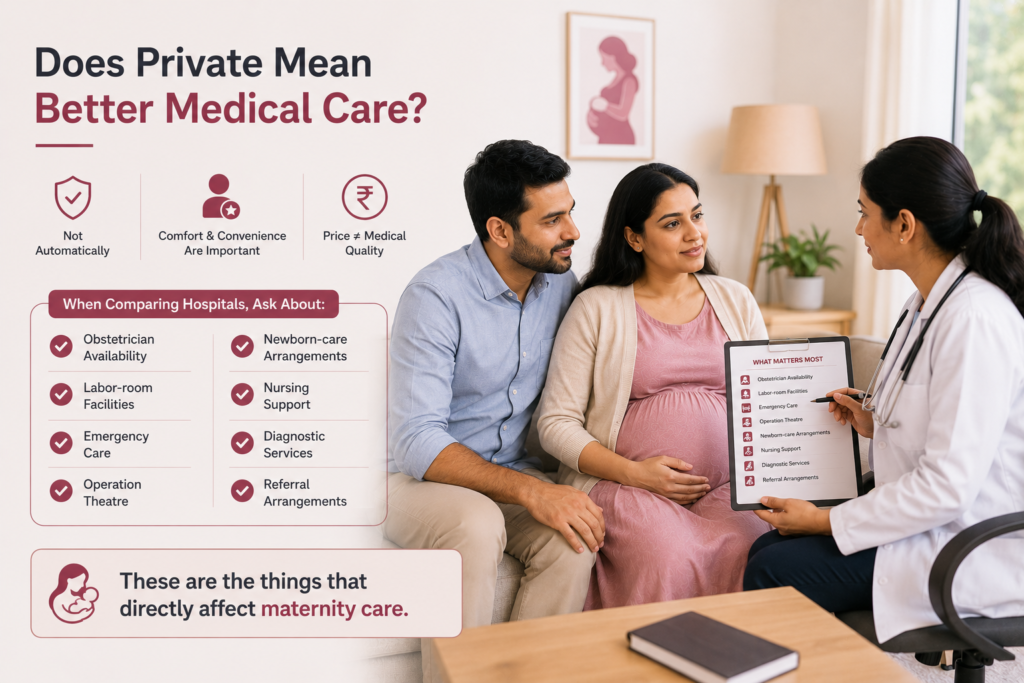
Does Private Mean Better Medical Care?
Not automatically.
Private hospitals may offer advantages such as greater privacy, more room choices and potentially more convenience.
But price isn’t a direct measure of medical quality.
When comparing hospitals, ask about:
- Obstetrician availability
- Labor-room facilities
- Emergency care
- Operation theatre
- Newborn-care arrangements
- Nursing support
- Diagnostic services
- Referral arrangements
These are the things that directly affect maternity care.
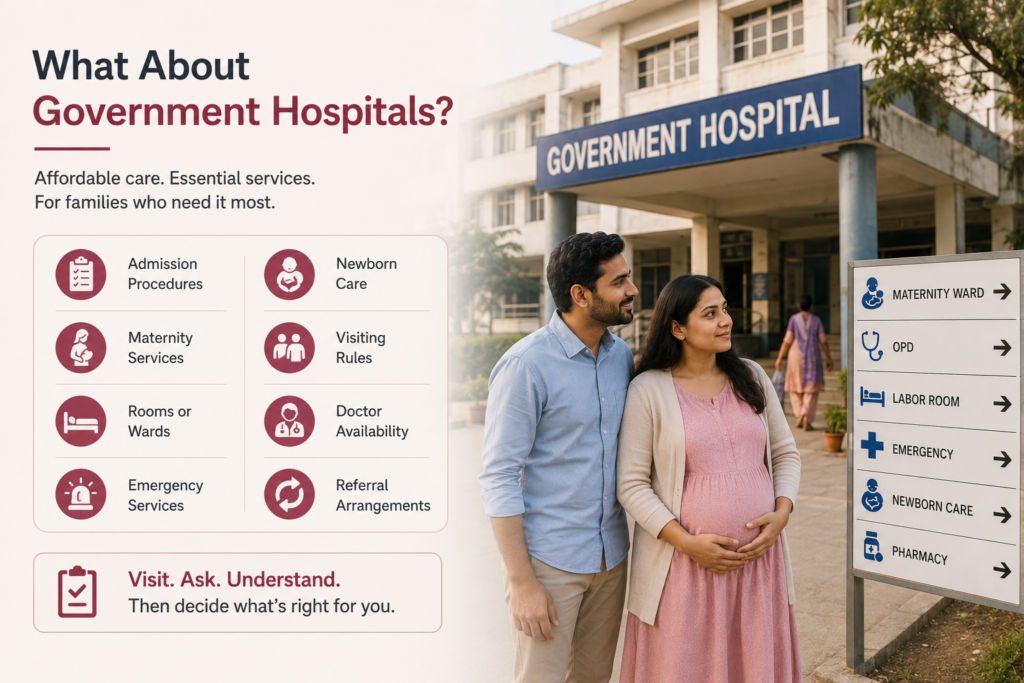
What About Government Hospitals?
Government hospitals can be an important option for families who want affordable maternity care.
Many public facilities provide comprehensive medical services and are designed to serve large numbers of patients.
The experience, however, can vary depending on the facility, patient volume and available infrastructure.
Before deciding, visit the hospital and ask practical questions.
Find out about:
- Admission procedures
- Maternity services
- Available rooms or wards
- Emergency services
- Newborn care
- Visiting rules
- Doctor availability
- Referral arrangements
Don’t rely on assumptions about what a government hospital does or doesn’t provide.
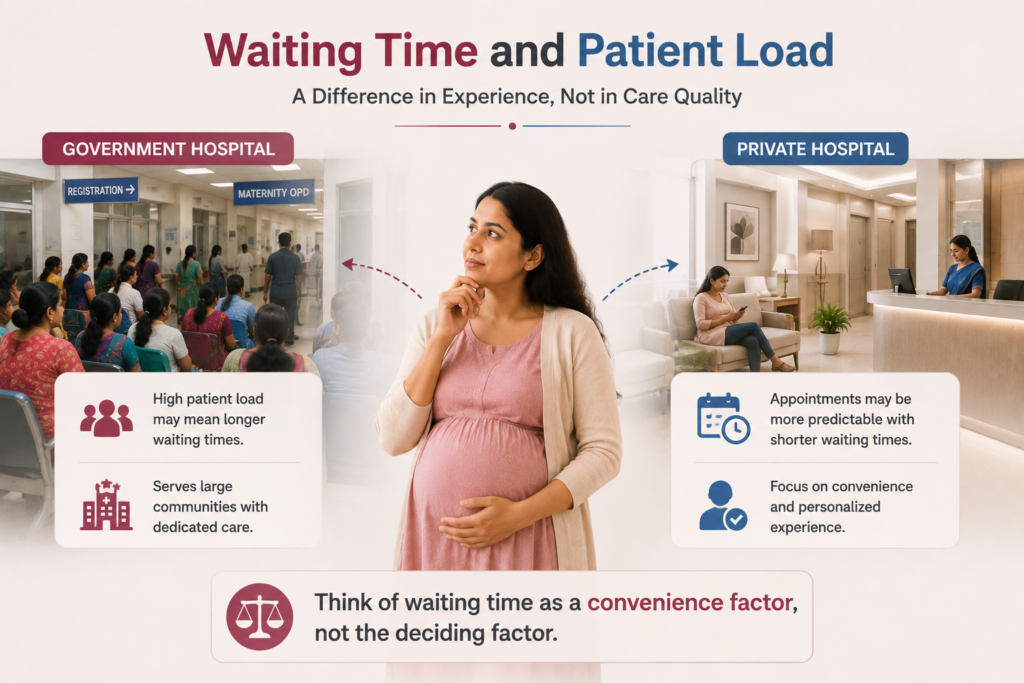
Waiting Time and Patient Load
This is another difference families often notice.
Government facilities may have a high patient load, which can affect waiting times and the overall experience.
Some private hospitals may offer more predictable appointments and potentially shorter waiting times.
But this isn’t a medical-quality ranking.
A busy government hospital may be busy because it serves a large community.
Likewise, a private hospital’s shorter waiting time doesn’t automatically mean it provides better medical care.
Think of waiting time as a convenience factor, not the deciding factor.
What About Privacy and Room Comfort?
If privacy is important to you, this may influence your decision.
Private hospitals often offer several room categories, while government hospitals may have fewer options depending on the facility.
You may be able to choose between:
- General ward
- Shared room
- Semi-private room
- Private room
Again, these differences are mainly about comfort and privacy.
A private room doesn’t automatically mean safer delivery, and a shared ward doesn’t automatically mean poor care.
Which Hospital Is Better for Normal Delivery?
This is one of the most common questions.
And the answer may be different from what you expect.
Neither private nor government hospitals can guarantee a normal delivery simply because they advertise it.
Whether a woman has a vaginal delivery depends on several factors, including:
- Her health
- Baby’s position
- Pregnancy complications
- Previous delivery history
- Labor progression
- Baby’s condition during labor
A good maternity team should support vaginal delivery when it is appropriate while also being prepared to recommend another approach when medically necessary.
Be cautious about promises such as “100% normal delivery.”
Pregnancy is not predictable enough for a responsible doctor to guarantee the outcome in advance.
What About C-Section Rates?
Some families try to choose a maternity hospital by looking for the lowest C-section rate.
That number can be useful as one piece of information, but it shouldn’t be interpreted on its own.
WHO explains that C-section rates can vary between hospitals because hospitals treat different patient populations. A referral hospital may receive more complicated pregnancies and therefore have a different C-section rate than a hospital mainly treating low-risk pregnancies.
So rather than asking:
“Which hospital has the lowest C-section rate?”
a better question is:
“How does the hospital decide when a C-section is medically necessary?”
That conversation tells you much more.
High-Risk Pregnancy Changes the Equation
If your pregnancy is considered high-risk, medical capability should take priority over room comfort or cost alone.
Your doctor may recommend closer monitoring if you have conditions such as:
- Pregnancy-related high blood pressure
- Diabetes
- Previous C-section
- Multiple pregnancy
- Placental problems
- Risk of preterm delivery
- Other maternal or fetal concerns
This doesn’t automatically mean that you need a particular type of hospital.
But it does mean that you should understand whether the facility can provide the level of care your pregnancy requires.
Ask your obstetrician directly:
“Is this hospital equipped for my pregnancy, including if an emergency occurs?”
Questions to Ask a Private Maternity Hospital
If you’re considering a private maternity hospital, ask:
- Who will conduct my delivery?
- Is the obstetrician available during emergencies?
- What is the estimated cost?
- What does the delivery package include?
- What isn’t included?
- What are the room charges?
- Is emergency OT available?
- What newborn-care facilities are available?
- Is paediatric support available?
Don’t feel uncomfortable asking about money.
Knowing the expected costs beforehand can prevent unnecessary stress later.
Questions to Ask a Government Maternity Hospital
If you’re considering a government facility, ask:
- What is the admission process?
- What documents are required?
- What maternity services are available?
- What are the available ward/room arrangements?
- What emergency services are available?
- Is newborn resuscitation available?
- What happens if specialised care is required?
- What are the visiting rules?
A short visit can answer many questions that online searches cannot.
So, Which One Should You Choose?
A private maternity hospital may be a good fit if you value:
- Greater privacy
- More room choices
- Convenience
- Potentially shorter waiting times
- Continuity with a particular doctor
- A private-care experience
A government hospital may be attractive if you prioritize:
- Lower costs
- Access to public healthcare services
- A facility capable of managing your pregnancy
- Affordability over room comfort
But there is no universal answer.
The hospital’s actual facilities and your individual medical situation matter more than whether the sign outside says “private” or “government.”
Don’t Make the Decision Based on Google Reviews Alone
Online reviews can tell you about things such as staff behavior, cleanliness or waiting times.
But they cannot tell you everything about medical care.
A maternity hospital should be evaluated using several sources:
- Your obstetrician’s recommendation
- Hospital facilities
- Emergency preparedness
- Newborn-care arrangements
- Costs
- Location
- Your own experience during a hospital visit
Reviews can be one input, not the entire decision.
Choosing a Maternity Hospital in Palam
Families searching for maternity care in Palam and nearby areas have several options.
You may come across government facilities as well as private maternity and multispecialty hospitals.
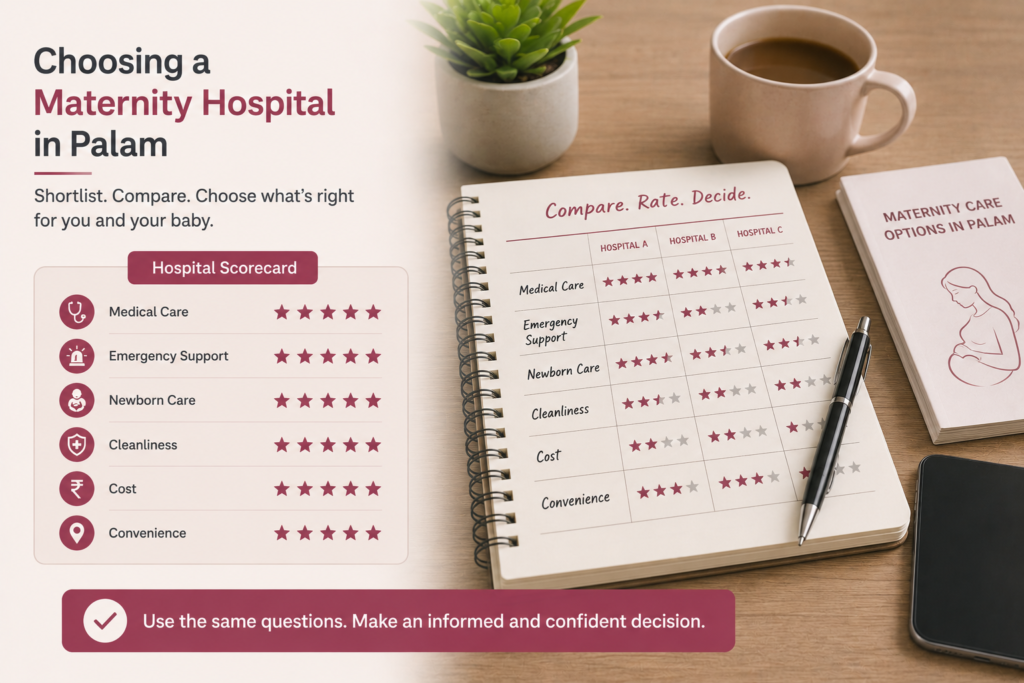
Rather than making your decision from an online list, shortlist a few hospitals and compare them using the same questions.
Create a simple scorecard:
Medical care: ★★★★★
Emergency support: ★★★★★
Newborn care: ★★★★★
Cleanliness: ★★★★★
Cost: ★★★★★
Convenience: ★★★★★
This makes the decision much more objective.
Final Thoughts
There is no simple answer to “private or government maternity hospital?”
The better question is:
“Which hospital can provide the right level of care for my pregnancy while fitting my budget and preferences?”
If affordability is your main concern, a government facility may make sense.
If privacy, convenience and room choice matter more, a private hospital may be more suitable.
But whichever option you choose, don’t compromise on the basics:
appropriate obstetric care, emergency preparedness, newborn care and a clear understanding of costs.
If you’re planning a delivery in Palam, visit your shortlisted hospitals before the due date and discuss your pregnancy with your obstetrician. A little preparation now can make the delivery experience much less stressful later.