
If you’re pregnant, there’s a good chance you’ve heard this question from family, friends or even yourself: “Will I have a normal delivery?”
It is one of the most common concerns during pregnancy.
Many women search online for terms such as normal delivery success rate, normal delivery chances or even which hospital has the highest normal delivery rate.
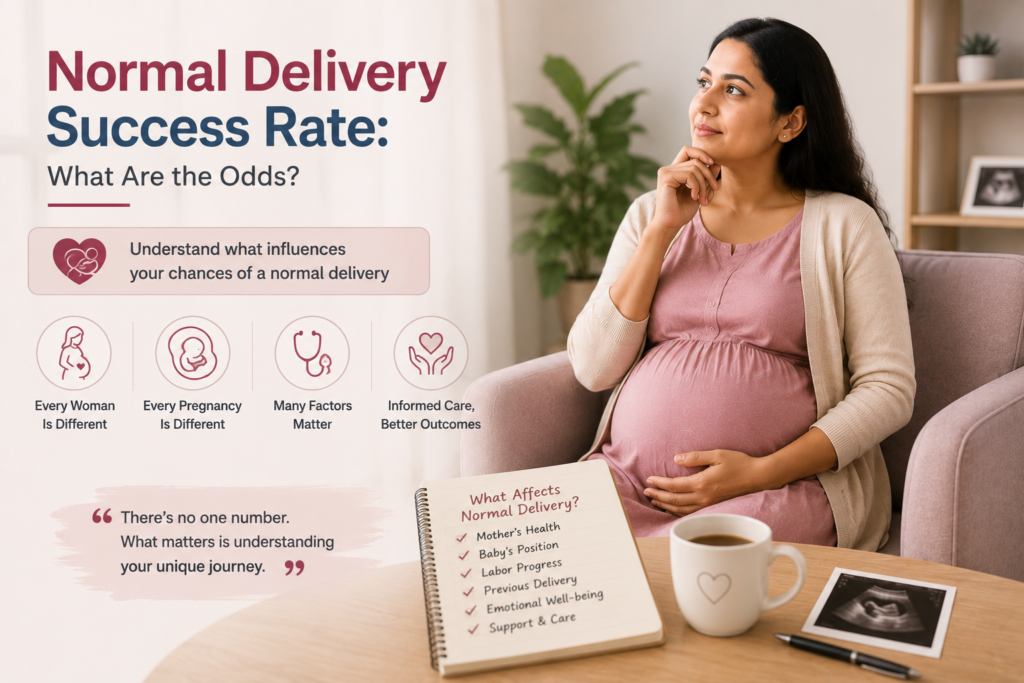
The problem is that there isn’t one percentage that can tell you what will happen in your pregnancy.
Every woman is different. Every pregnancy is different. And sometimes, even when everything looks normal during pregnancy, circumstances can change during labor.
So instead of looking for a guaranteed number, it is more useful to understand what actually influences the chances of vaginal delivery.
First, What Do We Mean by “Normal Delivery”?
“Normal delivery” is a term commonly used in everyday conversation to describe a vaginal birth.
Healthcare professionals may use more specific terms, including:
- Vaginal birth
- Spontaneous vaginal delivery
- Assisted vaginal delivery
- Caesarean delivery
Not every vaginal birth follows exactly the same process.
Some women go into labor naturally. Others may require induction. Some may need assistance during the final stage of labor.
The important point is that the goal of maternity care should not simply be to achieve a particular label.
The goal is a safe delivery for both mother and baby.
Is There a Fixed Normal Delivery Success Rate?
No.
You may find hospitals advertising very high “normal delivery rates,” but you need to be careful about interpreting those numbers.
A percentage doesn’t tell you:
- What type of patients were included
- How many were first-time mothers
- How many had previous C-sections
- How many pregnancies were high-risk
- How many were referred to the hospital because of complications
- What the hospital’s patient population looked like
This context matters.
WHO has specifically explained that C-section rates differ between hospitals because hospitals treat different patient populations. Referral hospitals, for example, may receive more complicated cases than facilities mainly treating lower-risk pregnancies.
So, there isn’t a single percentage that can accurately predict your individual chances.
Your Previous Pregnancy Can Make a Difference
One of the first things your obstetrician will want to know is your pregnancy and delivery history.
If you’ve previously had a vaginal delivery, that history becomes part of the assessment of your current pregnancy.
If this is your first pregnancy, your doctor will assess your pregnancy based on the factors present now.
Previous experience can provide useful information, but it doesn’t guarantee that the next delivery will happen in exactly the same way.
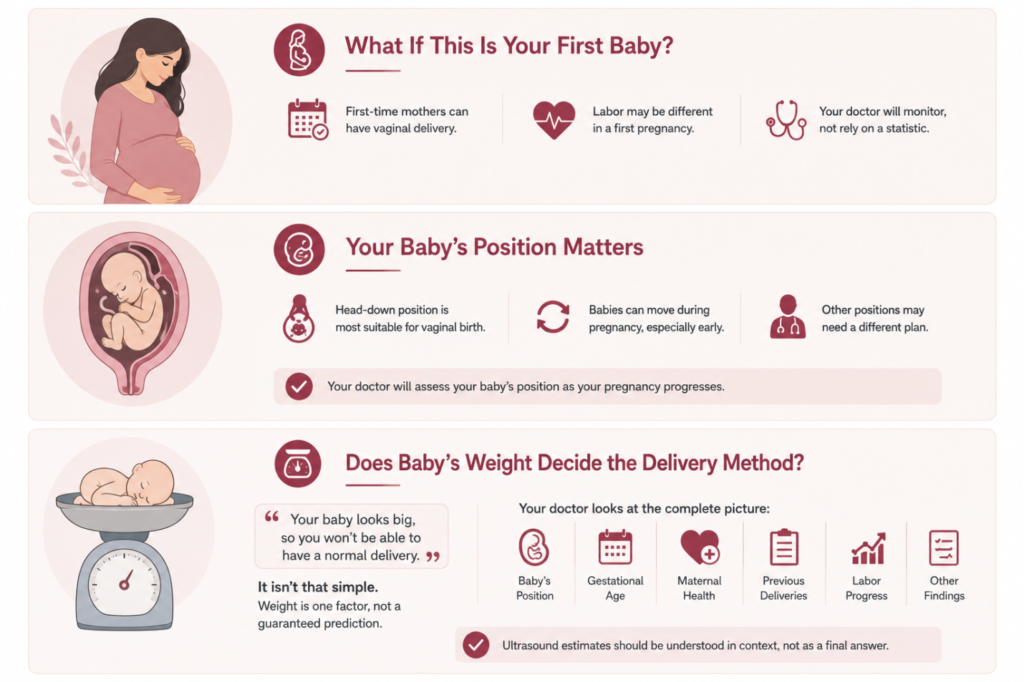
What If This Is Your First Baby?
Being a first-time mother does not mean you cannot have a vaginal delivery.
However, labor can behave differently in a first pregnancy compared with subsequent pregnancies.
Your doctor will monitor your pregnancy and, later, your labor rather than relying on a single statistic.
This is one reason prenatal check-ups are important.
Your Baby’s Position Matters
The position of the baby can influence delivery planning.
A baby who is head-down is generally in the position most commonly associated with vaginal birth.
But babies can move during pregnancy, particularly earlier on.
Other positions, such as breech or transverse lie, may require a different discussion with your obstetrician.
So, if your baby is not head-down at an earlier stage of pregnancy, don’t immediately assume that a C-section will be necessary.
Your doctor will assess the baby’s position as your pregnancy progresses.
Does Baby’s Weight Decide the Delivery Method?
This is another common concern.
You may hear someone say:
“Your baby looks big, so you won’t be able to have a normal delivery.”
It isn’t that simple.
Estimated fetal weight can be one factor doctors consider, but it isn’t a guaranteed prediction of whether vaginal delivery will be possible.
Your obstetrician looks at the complete picture, including:
- Baby’s position
- Gestational age
- Maternal health
- Previous deliveries
- Labor progress
- Other pregnancy findings
An ultrasound estimate should therefore be interpreted in context rather than treated as a final answer.
Your Health During Pregnancy Matters Too
Certain health conditions can affect pregnancy and delivery planning.
These can include:
- High blood pressure
- Diabetes during pregnancy
- Certain heart conditions
- Other medical conditions
- Pregnancy-specific complications
Having one of these conditions doesn’t automatically mean that you will need a C-section.
What matters is how the condition is affecting you and your baby and how well it is being managed.
This is why regular antenatal care matters.
What Happens to the Placenta?
Your obstetrician may also monitor the placenta during pregnancy.
Certain placental conditions can influence delivery planning.
Your doctor may look at:
- Placental location
- Bleeding
- Fetal growth
- Amniotic fluid
- Other ultrasound findings
If everything is progressing normally, your delivery plan can continue accordingly.
If something changes, your doctor may discuss whether the plan needs to change.
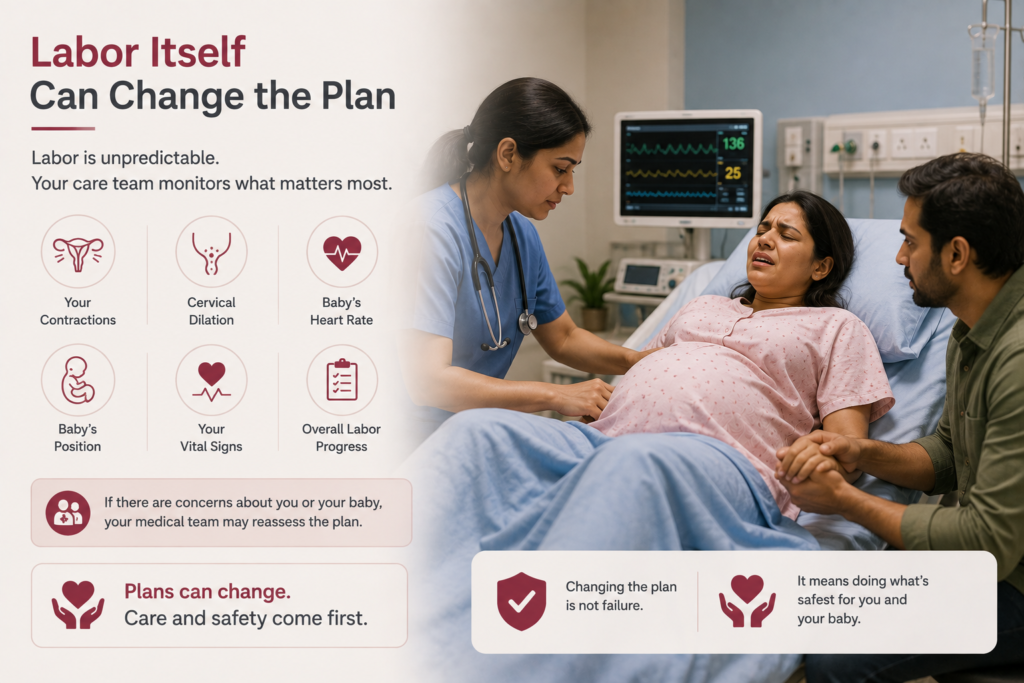
Labor Itself Can Change the Plan
This is perhaps the most important thing for expecting parents to understand.
You can have a healthy pregnancy and still experience an unexpected issue during labor.
Doctors may monitor:
- Your contractions
- Cervical dilation
- Baby’s heart rate
- Baby’s position
- Your vital signs
- Overall labor progress
If labor is not progressing as expected or there are concerns about the mother or baby’s wellbeing, the medical team may need to reassess the delivery plan.
That doesn’t mean anyone “failed.”
It means the circumstances changed.
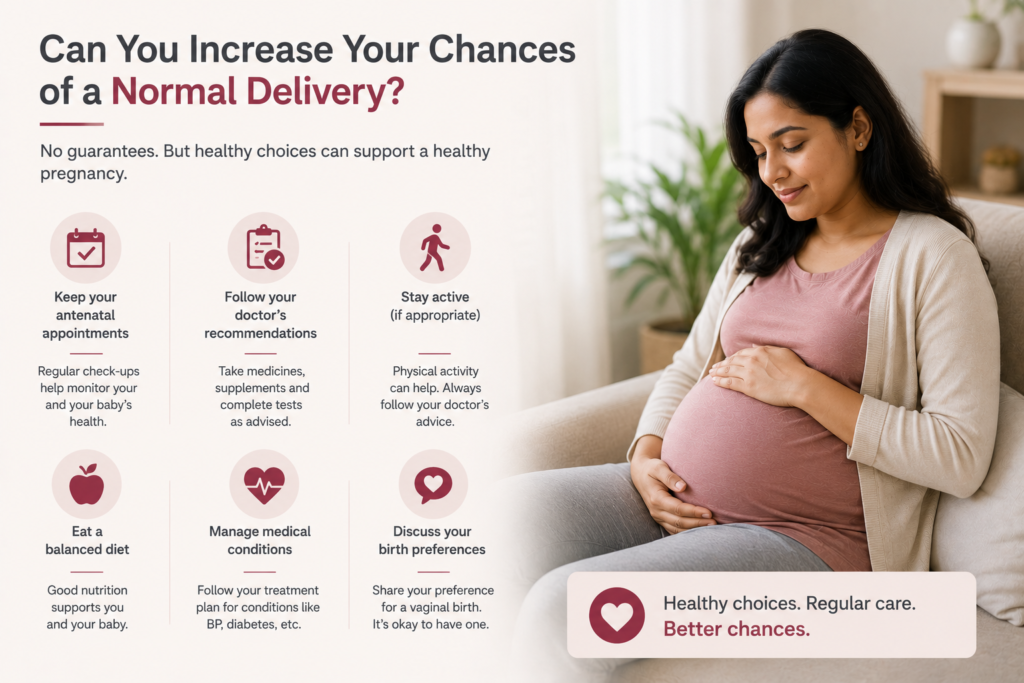
Can You Increase Your Chances of a Normal Delivery?
There is no method that guarantees vaginal delivery.
However, you can support a healthy pregnancy by taking sensible steps.
Keep your antenatal appointments
Regular appointments give your doctor an opportunity to monitor your health and your baby’s growth and development.
Follow your doctor’s recommendations
Take medicines and supplements as prescribed and complete recommended investigations.
Stay active if your doctor says it’s appropriate
Physical activity can be beneficial during pregnancy for many women, but the right level depends on your health and pregnancy.
Don’t start a new exercise routine without discussing it with your healthcare professional.
Eat a balanced diet
Good nutrition supports your health throughout pregnancy.
Manage medical conditions
If you develop high blood pressure, diabetes or another pregnancy-related condition, follow your doctor’s treatment and monitoring plan.
Discuss your birth preferences
Tell your obstetrician that you’d prefer a vaginal birth if it is medically appropriate.
Having a preference is completely reasonable.
Expecting a guaranteed outcome is different.
What About Normal Delivery After a C-Section?
This is an important question for women who have previously undergone a C-section.
Some women may be candidates for VBAC — vaginal birth after caesarean.
But VBAC isn’t appropriate for everyone.
Your doctor may consider:
- Why the previous C-section was performed
- The type of uterine incision
- Your previous delivery history
- Your current pregnancy
- Baby’s position
- Other medical factors
- Whether appropriate emergency care is available
If you’re considering VBAC, discuss your individual situation with your obstetrician rather than relying on a generic success percentage from the internet.
Should You Choose a Hospital Based on Its Normal Delivery Rate?
This is where many families can get misled.
Suppose one hospital says it has a very high normal-delivery percentage.
That sounds impressive.
But before deciding, ask:
Who are the patients included in that number?
A hospital that mainly manages low-risk pregnancies may naturally have a different delivery profile from a referral center that receives complicated pregnancies.
This is why WHO advises against treating a single hospital C-section rate as a universal target.
The same caution applies when interpreting a hospital’s normal-delivery percentage.
Instead of focusing on one number, ask about:
- The type of pregnancies the hospital manages
- Emergency facilities
- Labor-room monitoring
- Newborn care
- Availability of obstetricians
- Emergency C-section capability
Is Normal Delivery Always Better Than C-Section?
This is another area where social media and family advice can become confusing.
Vaginal birth can have advantages, including avoiding major abdominal surgery and generally involving a shorter surgical recovery.
But that doesn’t mean C-section is “bad.”
Sometimes a C-section is the safest option for the mother or baby.
WHO states that C-section can be lifesaving when medically necessary, while unnecessary C-sections also carry risks.
So rather than thinking:
Normal delivery = good
C-section = bad
think:
The safest medically appropriate delivery = the goal.
When Should You Stop Focusing on “Normal Delivery”?
It’s perfectly fine to hope for a vaginal birth.
But if a medical problem develops, the priority needs to shift.
Instead of asking:
“How can I avoid a C-section?”
the more important question becomes:
“What is safest for my baby and me?”
Depending on the situation, your doctor may recommend a C-section or another intervention.
Changing the delivery plan because circumstances changed isn’t a failure.
It’s part of responsible maternity care.
Questions to Ask Your Obstetrician
Rather than asking only for a normal delivery percentage, ask questions that relate specifically to your pregnancy:
- Is my pregnancy currently low-risk?
- Is my baby in a favorable position?
- Are there any factors that could affect vaginal delivery?
- How is my baby’s growth?
- Is my health affecting the pregnancy?
- What could change my delivery plan?
- What happens if labor doesn’t progress?
- Under what circumstances would a C-section become necessary?
- If I’ve had a previous C-section, could VBAC be an option?
- Does my chosen maternity hospital have emergency surgical and newborn-care facilities?
Your obstetrician can answer these questions using your actual medical history rather than a generic statistic.
If You’re Looking for Normal Delivery in Palam
Families searching for normal delivery in Palam often compare hospitals based on their advertised delivery rates.
Instead, look at the complete maternity-care setup.
Consider whether the hospital provides:
- Qualified obstetric care
- Appropriate labor-room facilities
- Maternal and fetal monitoring
- Newborn-care arrangements
- Emergency surgical support
- Experienced nursing staff
- Appropriate high-risk pregnancy support
- Clear communication with patients
You may find several maternity hospitals and multispecialty facilities serving Palam and surrounding areas. Before making a decision, confirm the hospital’s current facilities, doctor availability and delivery arrangements directly.
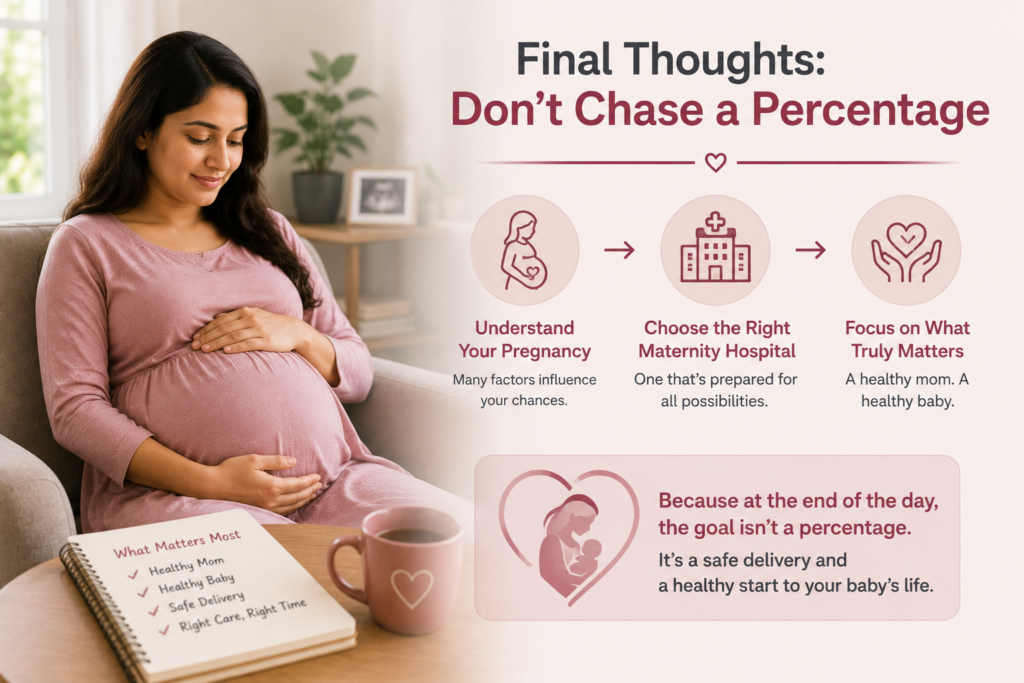
Final Thoughts: Don’t Chase a Percentage
If there is one thing to remember from this article, let it be this:
There is no normal delivery success rate that can predict your individual delivery.
Your chances depend on your pregnancy, your health, your baby’s condition, your previous pregnancy history and what happens during labor.
So instead of asking only:
“What percentage of women have a normal delivery here?”
try asking:
“Based on my pregnancy, what factors affect my chances of vaginal delivery?”
And then ask:
“If something changes during labor, how will the hospital respond?”
Those questions will give you much more useful information.
If you’re planning your delivery in Palam, discuss your preferences and concerns openly with your obstetrician. Choose a maternity hospital that is prepared not only to support a vaginal birth when appropriate, but also to provide timely care if the safest delivery plan needs to change.
Because at the end of the day, the goal isn’t a particular percentage.
The goal is a safe mother and a healthy baby.