
As your due date draws closer, it is completely natural to wonder about labour pain. Almost every expecting mother asks herself at some point: “How intense will it feel?” or “Is a painless delivery actually possible?”
Modern maternity care has made incredible strides in labour comfort. Today, expecting mothers do not have to endure labour without options. Depending on your preferences, health profile, and how labour unfolds, a range of non-medical comfort techniques and safe clinical pain relief methods can help you experience a smooth, manageable birth.
If you are exploring painless delivery options in Palam, having clear, realistic information helps you make confident choices for you and your baby.

What Does “Painless Delivery” Actually Mean?
In everyday conversations, the term painless delivery usually refers to a vaginal birth assisted by medical pain management—most notably epidural anesthesia.
However, it is helpful to look at “painless delivery” as a spectrum of effective pain relief rather than a total absence of sensation:
- Sensation vs. Pain: An epidural significantly dulls or eliminates sharp contraction pain, though you will still feel mild pressure as your baby descends. This pressure is helpful because it tells your body when and how to push.
- Individual Choice: Pain management is deeply personal. Some mothers choose natural non-medical techniques, others opt for an epidural early on, and many combine both.

Why Labour Pain Feels Different for Everyone
No two birth stories are identical. The way labour feels depends on several physical and emotional variables:
- Labour Dynamics: The strength, frequency, and pace of your uterine contractions.
- Baby’s Position: Whether your baby is facing anterior (head-down, back facing your front) or posterior (“back-to-back,” which can cause deeper lower back discomfort).
- Anatomy & Experience: Whether this is your first baby or a subsequent delivery, as well as individual pain thresholds and pelvic flexibility.
- Mindset & Environment: Emotional support, feeling safe, and staying calm reduce stress hormones like adrenaline, which can otherwise make pain feel more intense.
Non-Medical Comfort Methods for Labour
Natural pain management focuses on relaxing the nervous system, encouraging labour momentum, and helping you work with your contractions.

1. Controlled Breathing & Visualization
Deep, rhythmic breathing acts as an anchor during intense waves. Inhaling slowly through the nose and exhaling fully through the mouth keeps your muscles relaxed, oxygenates the uterus, and prevents holding your breath during contractions.
2. Active Movement & Upright Positions
Gravity is one of your best allies in the birthing room. Sitting or lying flat on a bed can make contractions feel stronger. When safe and monitored, moving around encourages your baby to settle deeper into the pelvis.
Effective labour postures include:
- Swaying or slow dancing with your support partner
- Sitting upright on a birth ball to relieve pelvic pressure
- Kneeling over a bed or leaning forward to ease back labour
- Side-lying with a peanut ball during rested phases
3. Gentle Massage & Counter-Pressure
Firm pressure applied to the lower back (sacral counter-pressure) during contractions can significantly ease deep aches, particularly if your baby is in a posterior position.
Medical Pain Relief Options
When natural techniques need an extra boost, or if you prefer a predictable layer of relief, medical options provide reliable comfort.
Epidural Anesthesia
An epidural is the gold standard for labour pain relief worldwide.
- How It Works: A specialist anesthesiologist places a tiny, flexible tube (catheter) into the epidural space of your lower back. Small, continuous doses of local anesthetic block pain signals from the waist down.
- The Experience: It takes roughly 10 to 15 minutes to perform and starts taking effect within 15 to 20 minutes. You remain fully awake, alert, and conscious of your baby’s birth, but the sharp pain of contractions turns into a manageable feeling of mild pressure.
Is an Epidural Safe?
When administered by a trained anesthesiologist in a equipped hospital environment, an epidural is considered safe for both mother and baby.
Before placing an epidural, your obstetrician and anesthesiologist evaluate:
- Your general medical history and blood count (platelets)
- Your current stage of labour and cervix dilation
- Routine fetal heart rate monitoring
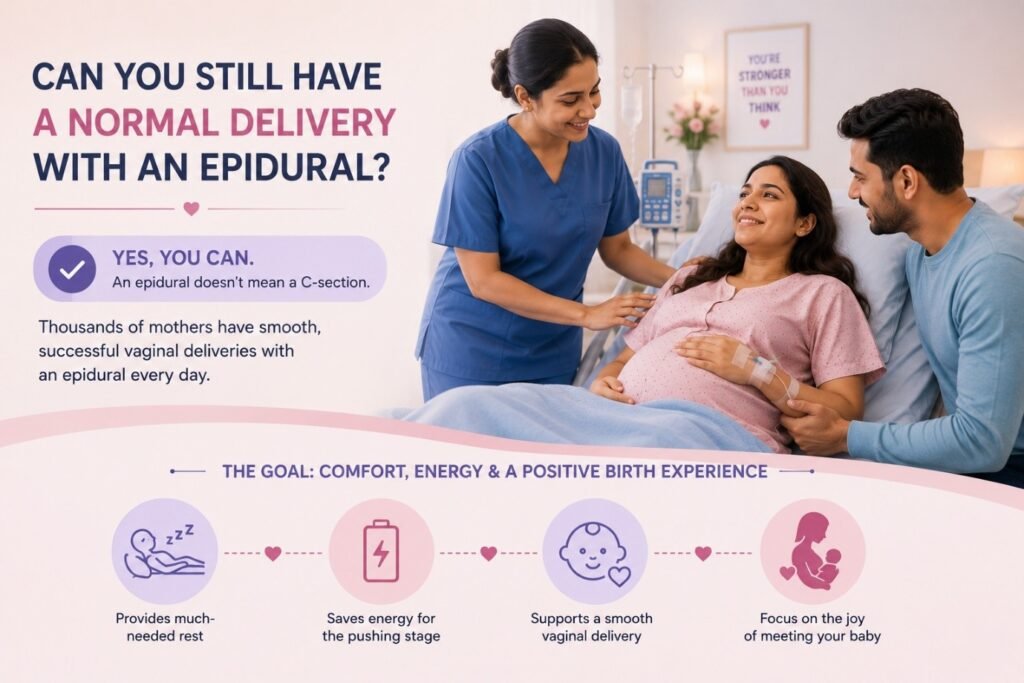
Can You Still Have a Normal Delivery with an Epidural?
Yes. Receiving an epidural does not mean you will need a C-section. Thousands of mothers have smooth, successful vaginal deliveries with an epidural every day. The primary goal of an epidural is comfort—it simply gives you rest so you have energy left for the pushing stage.
How to Prepare for a Comfortable Birth Experience
- Discuss Pain Preferences Early: Share your thoughts on pain relief with your gynecologist during routine antenatal check-ups.
- Draft a Flexible Birth Plan: Outline your preferences (e.g., “I’d like to try movement first, but remain open to an epidural if labour is prolonged”). Staying adaptable prevents unexpected stress.
- Take Childbirth Preparation Classes: Understanding the stages of labour demystifies the process, making you feel prepared rather than anxious.
- Choose an Equipped Maternity Center: Ensure your chosen hospital has 24/7 obstetric monitoring, dedicated nursing care, and round-the-clock anesthesia support.
Personalized Maternity Care at Angel Agastya Hospital
At Angel Agastya Hospital in Palam, Dr. Kalpana Aggarwal offers compassionate, evidence-based maternity and delivery care for mothers across Palam, Dwarka, Sagarpur, Delhi Cantt, and Uttam Nagar.
Our maternity center provides:
- Personalized Labour Monitoring: Respectful care tailored to your individual birth plan.
- Epidural & Pain Management Support: Dedicated anesthesia care for safe, painless delivery options.
- Comprehensive Antenatal & High-Risk Care: Expert oversight for routine and complex pregnancies alike.
- Postpartum & Newborn Care: Gentle guidance as you transition into motherhood.

Frequently Asked Questions
1. Does an epidural completely numb my legs?
You may feel a warm, heavy sensation in your lower body, but modern epidurals are titrated to reduce sharp pain while allowing you enough mobility and sensation to feel pressure when it is time to push.
2. When is the best time during labour to ask for an epidural?
An epidural can usually be placed once labour is active and established. Your obstetrician will check your cervical dilation and contraction pattern to advise on the ideal timing.
3. Does an epidural slow down labour?
An epidural may slightly lengthen the pushing phase for some first-time mothers. However, by eliminating exhaustion and anxiety, it often gives mothers the rest they need to push effectively when the time comes.
4. Will I experience backache after an epidural?
Temporary tenderness at the injection site in your lower back for a few days after delivery is common. Long-term back pain is usually linked to pregnancy hormones (relaxin), posture shifts, and physical strain during pregnancy itself rather than the epidural catheter.
5. Can I walk around after getting an epidural?
Because an epidural alters sensation and muscle strength in your legs, continuous walking is generally paused for safety. However, you can still shift positions in bed with assistance.
6. How do I consult Dr. Kalpana Aggarwal for maternity care in Palam?
You can visit Angel Agastya Hospital in Palam to schedule a pregnancy consultation, review your birth options, and plan your delivery care directly with Dr. Kalpana Aggarwal.
Plan Your Delivery Care with Confidence
Whether you hope for a fully natural birth, plan on choosing an epidural, or simply want to understand all your options, expert care makes all the difference. Schedule a consultation with Dr. Kalpana Aggarwal at Angel Agastya Hospital to discuss your birth preferences and prepare for a safe, comfortable arrival for your baby.
📞 Call or WhatsApp us today to book your consultation.