
As your due date approaches, one question likely stands out above all others: “How long is this actually going to take?”
If you have asked around, you have probably heard vastly different stories. One friend might tell you her labour was over in a quick six hours, while another describes a 24-hour marathon. It is completely natural to wonder where your own birth experience will fall on that spectrum.
The short answer? There is no single “normal” timeline for childbirth.
On average, a first-time normal delivery lasts anywhere from 12 to 24 hours, while subsequent deliveries often move faster, averaging 6 to 12 hours. However, labour is a dynamic process. Rather than watching the clock, obstetricians focus on how labour is progressing and how well both mother and baby are doing.
Understanding the three distinct stages of labour—and what happens during each—can help demystify the process and give you peace of mind when the day arrives.
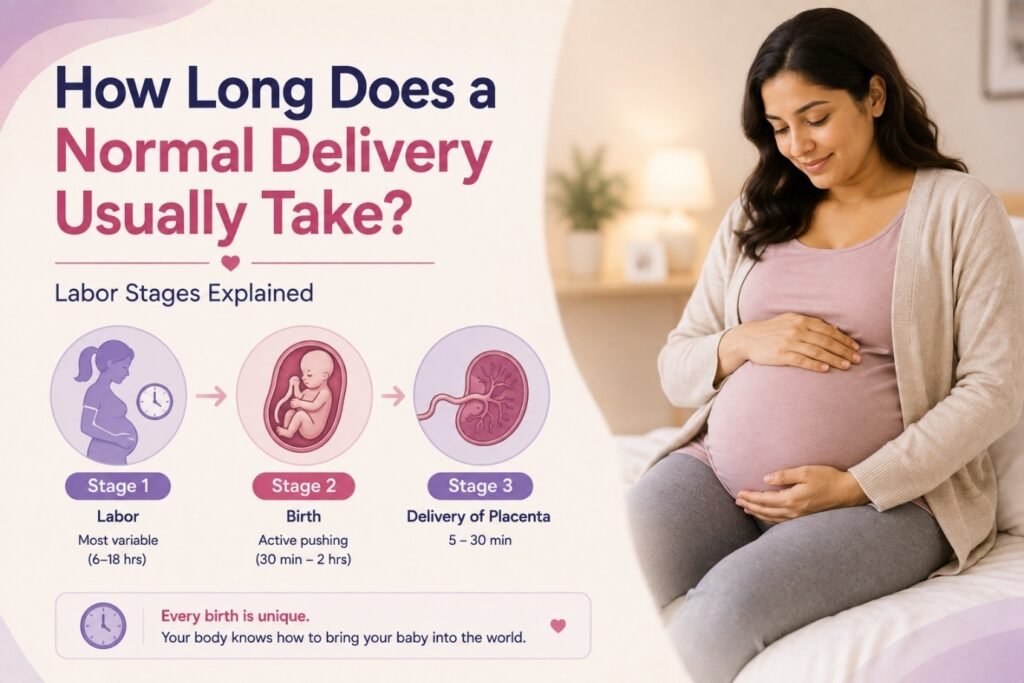
The 3 Stages of Labour & Their Timelines
Childbirth is clinically divided into three stages, starting from your very first true contractions all the way through delivering the placenta.
Stage 1: Cervical Dilation (The Longest Phase)
Stage 1 begins when regular uterine contractions start opening (dilating) and thinning (effacing) your cervix, and ends when you are fully dilated to 10 centimeters.
This stage is split into two distinct phases:
- Early (Latent) Labour: Your cervix dilates from 0 to 6 centimeters. Contractions are usually mild, irregular, and manageable.
- Duration: This is the most unpredictable phase. It can take 8 to 14 hours or more for a first pregnancy, or a few hours for subsequent births.
- Active Labour: Your cervix dilates from 6 to 10 centimeters. Contractions become stronger, longer (lasting 60–90 seconds), and occur every 2 to 3 minutes.
- Duration: Active labour typically progresses at a rate of about 1 cm per hour for first-time moms, usually lasting around 4 to 8 hours.

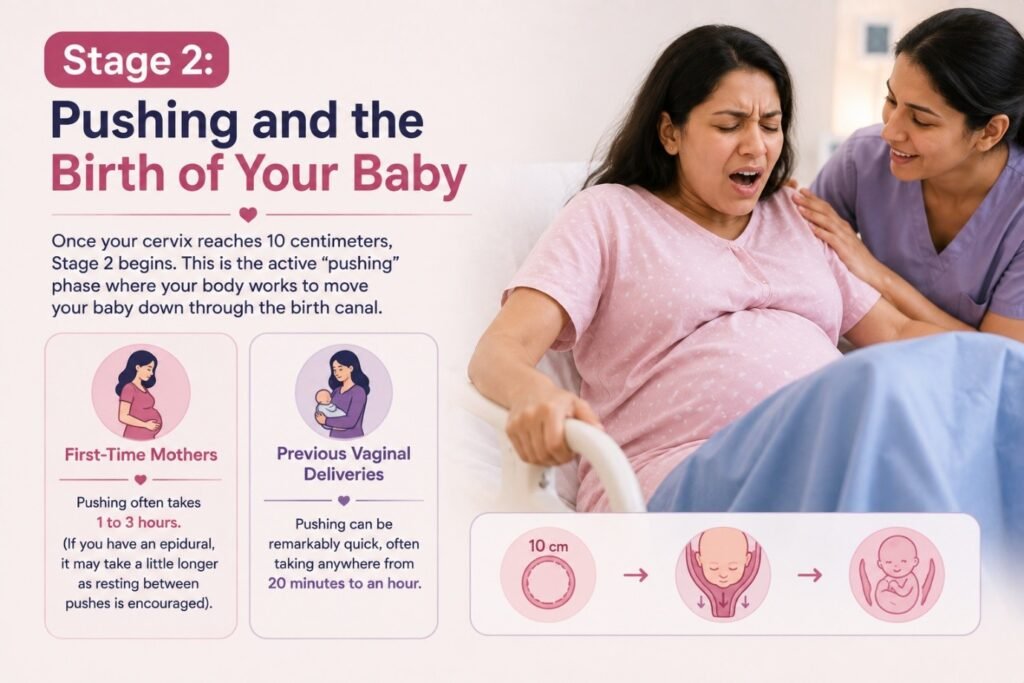
Stage 2: Pushing and the Birth of Your Baby
Once your cervix reaches 10 centimeters, Stage 2 begins. This is the active “pushing” phase where your body works to move your baby down through the birth canal.
- First-Time Mothers: Pushing often takes 1 to 3 hours. (If you have an epidural, it may take a little longer as resting between pushes is encouraged).
- Previous Vaginal Deliveries: Pushing can be remarkably quick, often taking anywhere from 20 minutes to an hour.
Stage 3: Delivery of the Placenta
After your baby is safely in your arms, labour isn’t quite over, but the hardest physical work is behind you. Your uterus gently contracts to separate the placenta from the uterine wall and express it.
- Duration: Stage 3 is short, typically lasting between 5 to 30 minutes.

Why First Deliveries Take Longer
It is very common for first-time labour to take longer than subsequent births. There are simple physiological reasons for this:
- Unstretched Tissues: Your cervical tissues, pelvic floor muscles, and birth canal are adapting to stretching for the very first time.
- Uterine Efficiency: The uterus is learning how to coordinate contractions most efficiently. In second or third pregnancies, the body “remembers” the pathway, allowing dilation and descent to happen more rapidly.
Factors That Influence Labour Duration
No two labours follow the exact same rhythm because several physiological variables come into play:
- Baby’s Position: A baby facing head-down and anterior (facing your back) applies even pressure on the cervix, helping labour move along predictably. If the baby is posterior (“back-to-back”), labour may be slower and involve more lower back discomfort.
- Contraction Strength: Regular, powerful contractions dilate the cervix far more efficiently than irregular or weak waves.
- Maternal Movement: Changing positions, standing, or walking during early labour lets gravity assist the baby’s downward movement.
- Epidural Timing: An epidural provides exceptional pain relief, which helps relax tense muscles. While it can slightly extend the pushing phase, it also restores energy so you can push effectively.
Does a Longer Labour Mean You’ll Need a C-Section?
Not at all. A slow labour is simply a labour that needs time.
Obstetricians evaluate labour using a comprehensive clinical view (often guided by the 5 P’s of Delivery—Power, Passenger, Passage, Position, and Psychology). As long as your blood pressure and vitals are stable, your baby’s heart rate remains steady, and progress continues safely, a longer labour can still lead to a smooth, natural vaginal delivery.
A cesarean section is only recommended if there are signs of fetal distress, a complete stall in progress despite supportive measures, or medical complications that make continued labour unsafe.

How to Prepare for Labour Momentum
While you cannot dictate the exact hours your labour will take, you can support your body’s stamina:
- Stay Active During Pregnancy: Daily walking, light stretching, and prenatal exercises build the physical endurance needed for birth.
- Rest Early in Labour: When early labour begins at home, resist the urge to pace immediately. Save your energy, rest, hydrate, and eat light meals while contractions are mild.
- Practice Deep Breathing & Relaxation: Tensing up during contractions consumes vital energy. Deep breathing keeps oxygen flowing to your uterine muscles.
- Build a Supportive Birth Team: Partner support and an empathetic medical team lower anxiety, helping your body release natural oxytocin to power contractions.
Dedicated Maternity Care at Angel Agastya Hospital
At Angel Agastya Hospital in Palam, Dr. Kalpana Aggarwal provides personalized, patient-centered maternity and labour care for expecting mothers across Palam, Dwarka, Sagarpur, Uttam Nagar, and Delhi Cantt.
Our maternity care includes:
- Continuous Labour Monitoring: Careful oversight of both maternal and fetal well-being throughout every stage of labour.
- Support for Normal Delivery: Guidance on active birth positions, breathing techniques, and painless delivery options.
- High-Risk Pregnancy & VBAC Management: Specialized care for complex pregnancies requiring extra clinical oversight.
- Postpartum & Newborn Care: Complete medical support for mother and baby following birth.
Frequently Asked Questions
1. How many hours does a normal delivery usually take?
For first-time mothers, total labour usually ranges between 12 and 24 hours. For women who have given birth vaginally before, labour is often shorter, averaging 6 to 12 hours.
2. When should I go to the hospital after labour starts?
A common rule of thumb is the 5-1-1 rule: go to the hospital when contractions occur every 5 minutes, last for 1 full minute each, and continue this pattern for at least 1 hour. Always contact your gynecologist immediately if your water breaks or if you experience bleeding.
3. Can walking speed up labour?
Walking and remaining upright during early labour allows gravity to pull the baby’s head down against the cervix, which can encourage steady cervical dilation if labour has already begun.
4. What happens if labour stops or stalls?
If contractions slow down or stop progressing, your doctor will evaluate hydration, maternal fatigue, and baby positioning. Simple measures like changing positions, walking, resting, or administering IV fluids or oxytocin (Pitocin) can help restart labour momentum safely.
5. Does an epidural make labour last longer?
An epidural may add roughly 30 to 60 minutes to the pushing phase (Stage 2) because it softens muscle sensation. However, it often helps mothers rest during Stage 1, preventing total exhaustion.
6. Where can I consult an experienced obstetrician for delivery care near Palam?
You can consult Dr. Kalpana Aggarwal at Angel Agastya Hospital in Palam for expert guidance on labour preparation, birth planning, and personalized delivery care.
Prepare for Your Birth Story with Confidence
Every labour experience is unique, but going into birth with knowledge and trusted medical support makes all the difference. Schedule a pregnancy consultation with Dr. Kalpana Aggarwal at Angel Agastya Hospital to discuss your birth plan, understand your labour options, and prepare for a safe, positive birth experience.
📞 Call or WhatsApp us today to book your consultation.