
The ideal choice between a midwife and an OB-GYN depends on your personal health profile, your delivery preferences, and the level of medical support your pregnancy requires.
Both midwives and OB-GYNs play incredibly vital roles during childbirth, but the right path forward is never a one-size-fits-all decision. As more women explore natural childbirth options and look for highly personalized maternity care, many expecting mothers find themselves asking an important question: should a midwife or an OB-GYN handle the delivery?
For families living across Palam, Dwarka, Uttam Nagar, and the surrounding neighborhoods of West Delhi, this decision often feels deeply emotional as well as practical. Some women want a calm and natural birth experience centered on continuous emotional support during labor, while others feel reassured by medical supervision and emergency readiness. The good news is that modern maternity care no longer treats these two approaches as opposites. In many advanced healthcare systems, midwives and OB-GYNs work hand-in-hand to create a much safer, more supportive, and deeply comforting childbirth experience. Understanding the unique strengths of these care providers can help you move past fear or confusion and make a truly confident, informed decision for your family.
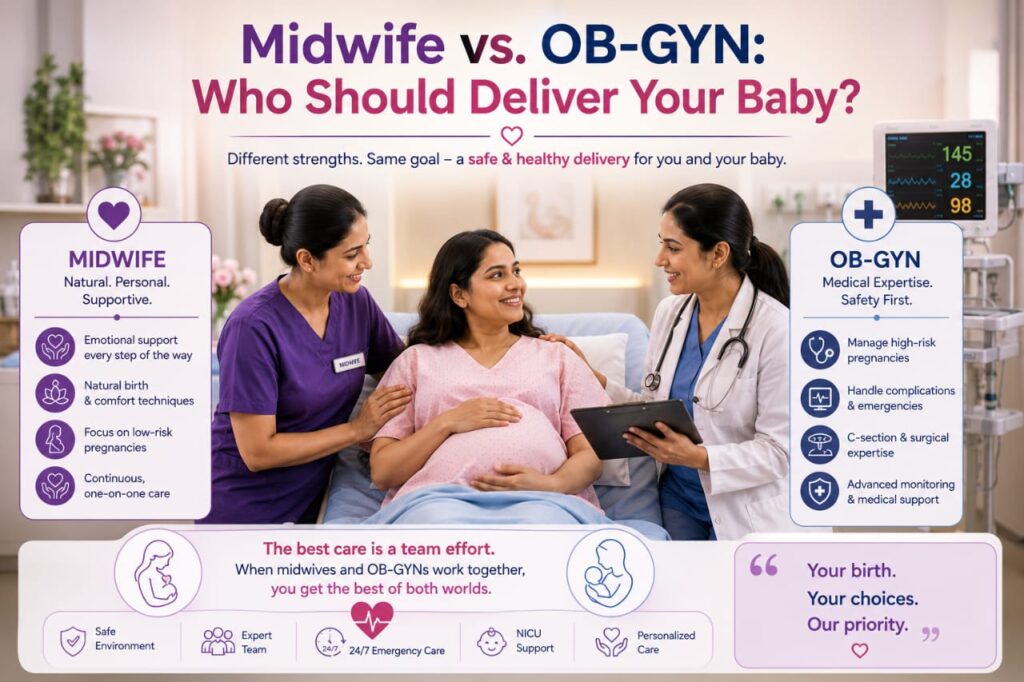
Who Is a Midwife?
A midwife is a certified maternity professional dedicated to supporting low-risk pregnancies through natural birthing techniques, physical comfort, and emotional reassurance.
A midwife views pregnancy and childbirth as normal, healthy life events rather than medical conditions to be managed. They are commonly associated with natural childbirth because their care philosophy focuses heavily on the human element of labor offering continuous emotional encouragement and specialized physical comfort techniques. They act as your dedicated companion and medical guide, helping you connect with your body’s natural rhythms during the birthing process.
During active labor, a midwife provides continuous, hands-on assistance by guiding you through:
Breathing Techniques: Helping you maintain a calm, steady rhythm to manage the peak of contractions naturally.
Labor Positions: Encouraging movement, pacing, and strategic changes in posture to help the baby descend smoothly through the birth canal.
Relaxation Support: Creating a soothing, low-stress environment in the labor suite to keep your adrenaline low and your confidence high.
Emotional Encouragement: Standing by your side with constant words of affirmation, ensuring you never feel isolated or overwhelmed.
Monitoring Basic Labor Progress: Tracking your dilation and vital signs carefully to ensure your labor is advancing safely and naturally.
Women looking for a deeply personalized, gentle, and emotionally supportive vaginal delivery experience often feel incredibly comfortable with midwife-led care.
Midwives generally work best in low-risk pregnancies where everything is moving forward normally without underlying maternal complications. In recent years, hospital-based midwife support has become increasingly popular because it gives mothers the perfect balance between natural childbirth comfort and advanced clinical safety.
Who Is an OB-GYN?
An OB-GYN is a specialized medical doctor trained to handle the entire spectrum of pregnancy, from routine vaginal deliveries to high-risk clinical complications and surgeries.
An OB-GYN, or obstetrician-gynaecologist, is a physician who has dedicated years to mastering reproductive medicine and advanced surgical interventions. Unlike midwives, whose practice is centered around low-risk care, OB-GYNs are fully equipped to handle both routine arrivals and complex, unpredictable medical turnarounds. Their presence provides a powerful clinical safety net, ensuring that if a complication arises, you do not have to wait for an expert to arrive they are already leading your room.
OB-GYNs expertly manage critical pregnancy scenarios, including:
Pregnancy Complications: Tracking and treating unexpected changes in maternal or fetal health conditions.
Emergency Situations: Making rapid, high-precision clinical decisions when labor paths shift suddenly.
C-Sections: Performing surgical deliveries safely when a vaginal birth is no longer the safest path for the child.
High Blood Pressure during Pregnancy: Monitoring conditions like preeclampsia to protect the mother’s vascular health.
Gestational Diabetes: Designing metabolic and nutritional roadmaps to keep your baby’s growth on a healthy trajectory.
Fetal Distress during Labor: Reading subtle variations in fetal heart rate monitors to step in the exact second a baby shows signs of stress.
For women navigating high-risk pregnancies or living with underlying medical conditions, OB-GYN care is an absolute necessity. Their deep medical expertise ensures that both mother and baby receive immediate, lifesaving treatment if labor becomes unpredictable. Many women searching for a normal delivery specialist assume that choosing an OB-GYN automatically means a cold, highly medicalized birth experience. However, many experienced maternity doctors today strongly favor and support natural vaginal delivery whenever it is clinically safe, working patiently to give you the birth experience you desire.
Key Differences Between Midwife and OB-GYN Care
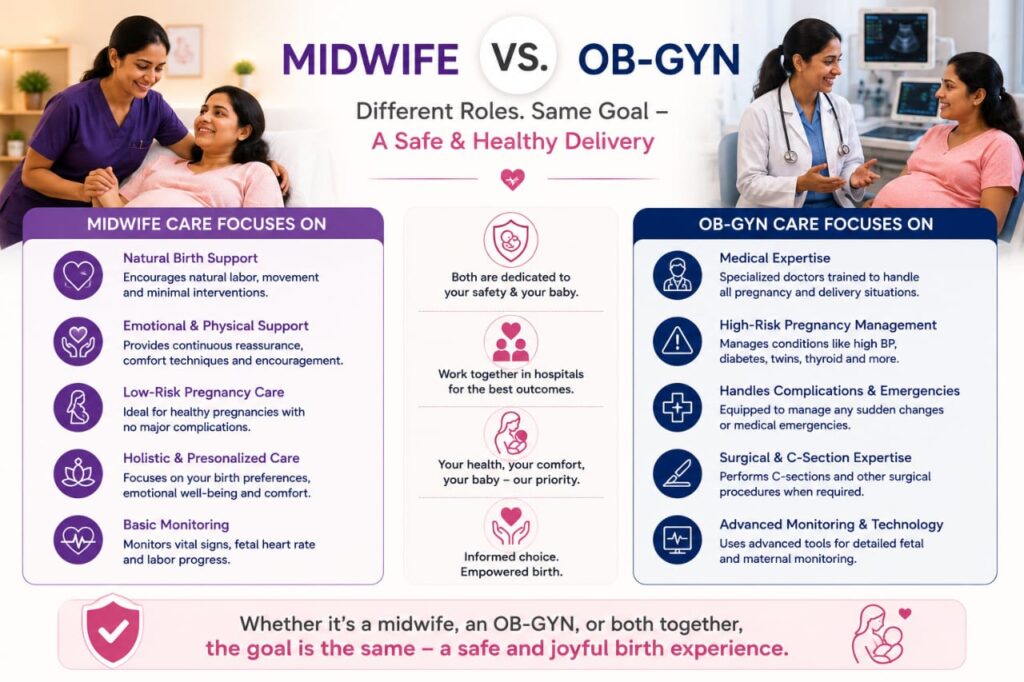
The primary difference lies in their scope of practice, where midwives focus on natural comfort and low-risk support, while OB-GYNs specialize in medical intervention and surgical readiness.
Although both providers share the ultimate goal of bringing your baby safely into the world, their training and daily clinical focus are distinct. A midwife looks at labor through the lens of physiological support, working to minimize medical interventions unless they are absolutely necessary. An OB-GYN looks at labor through the lens of clinical safety and risk management, keeping a close watch on data to protect you from potential complications.
Midwife care focuses on natural childbirth support, deep emotional reassurance during labor, low-risk pregnancy management, and continuous physical comfort techniques.
OB-GYN Care Focuses On: Advanced medical supervision, high-risk pregnancy management, immediate emergency intervention, and surgical delivery if required.
One of the most critical differences lies in how emergencies are handled. A midwife excels at supporting labor progression and physical comfort, but if a sudden complication arises, they must hand over care to a physician. An OB-GYN is fully trained to perform urgent medical procedures and surgeries on the spot. This is exactly why modern maternity hospitals now combine both approaches, blending the warmth of midwifery with the security of obstetrics to create a truly patient-centered childbirth experience.
When a Midwife May Be a Good Choice
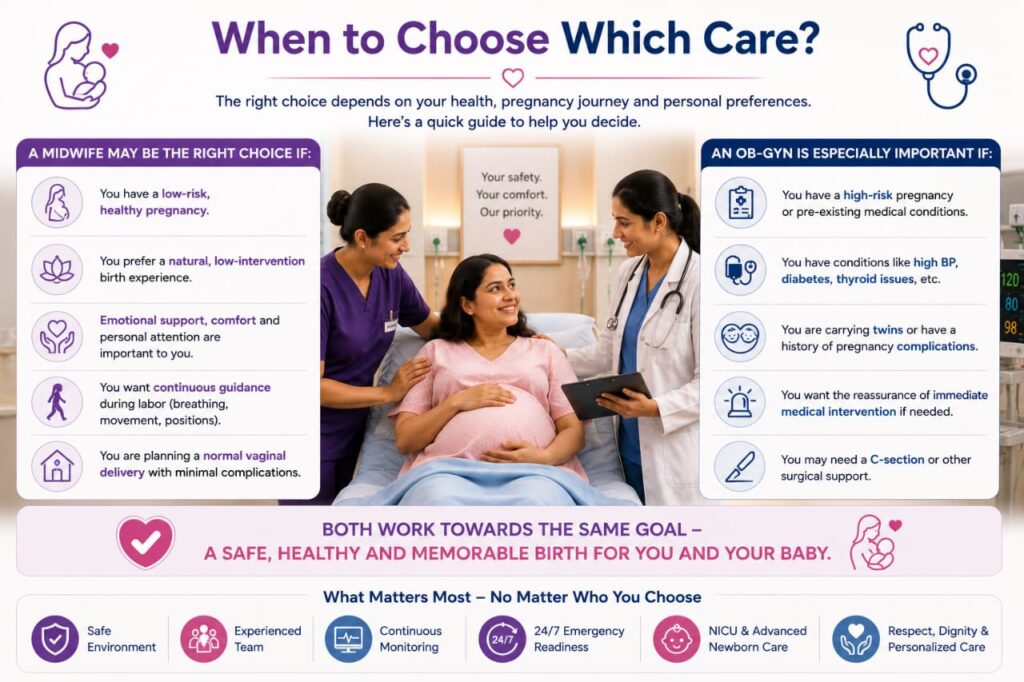
A midwife is an exceptional choice for mothers with low-risk pregnancies who want a highly personalized, natural birth experience centered on emotional intimacy.
Choosing a midwife works beautifully for women who have maintained a healthy pregnancy without blood pressure or blood sugar hurdles, and who feel a deep personal pull toward natural childbirth. If you feel anxious about cold, overly clinical environments, the gentle and continuous presence of a midwife can completely change your perception of labor. Having a dedicated professional guide your breathing, encourage physical movement, and offer unconditional emotional reassurance improves your confidence, helping your body relax. Women planning a normal vaginal delivery often appreciate this supportive, low-stress environment, which treats labor as a monumental family milestone rather than a medical emergency.
When an OB-GYN Is Especially Important
An OB-GYN is absolutely essential for pregnancies that involve pre-existing medical conditions, high-risk markers, or sudden variations during active labor..
An OB-GYN becomes the true guardian of your birth story if your pregnancy involves complexities such as high blood pressure, gestational diabetes, carrying multiples, or managing risks related to premature labor or past C-sections. Even for women who plan a completely natural childbirth, labor can take unexpected turns that require swift medical intervention. In those high-stakes moments, having immediate, bedside access to an experienced maternity doctor is what ensures a safe and sound delivery. This is why hospital-based childbirth support is inherently more secure than isolated, non-medical birth environments it ensures that advanced lifesaving tools are always standing by.
Can Midwives and OB-GYNs Work Together?
Yes, a collaborative care model that pairs a midwife’s continuous comfort with an OB-GYN’s medical authority provides the highest standard of modern maternity safety.
This integrated approach is rapidly becoming the preferred model for leading maternity centers. In a collaborative hospital system, you do not have to choose between emotional warmth and clinical safety.
Midwives remain by your side through every contraction, providing physical comfort, labor positioning guidance, and emotional strength.
OB-GYNs closely supervise the overarching medical parameters, tracking your data and ensuring complete emergency readiness.
This balance allows you to experience a highly personalized, natural childbirth while giving you the profound confidence that if a complication arises, an elite medical team is already in the room to protect your baby.
What Matters Most for a Safe Vaginal Delivery
A safe vaginal delivery relies on a robust hospital support system, seamless team coordination, and continuous monitoring, rather than a single title.
When you are planning your birth journey, the focus should shift away from choosing “one side” over the other. Childbirth is a dynamic process, and true safety depends on how well the surrounding medical environment can adapt to your needs. Families searching for pregnancy care in Palam or across West Delhi should focus heavily on the institutional standards of the hospital they choose.
A predictable, safe vaginal delivery depends on:
Continuous maternal and fetal monitoring to track your baby’s stamina.
An experienced, communicative maternity team that works without ego.
Immediate, 24/7 access to emergency operation theatres and advanced NICUs.
Skilled labor room staff who respect your dignity and practice patient-centered communication.
How Angel Agastya Hospital Supports Personalized Delivery Care
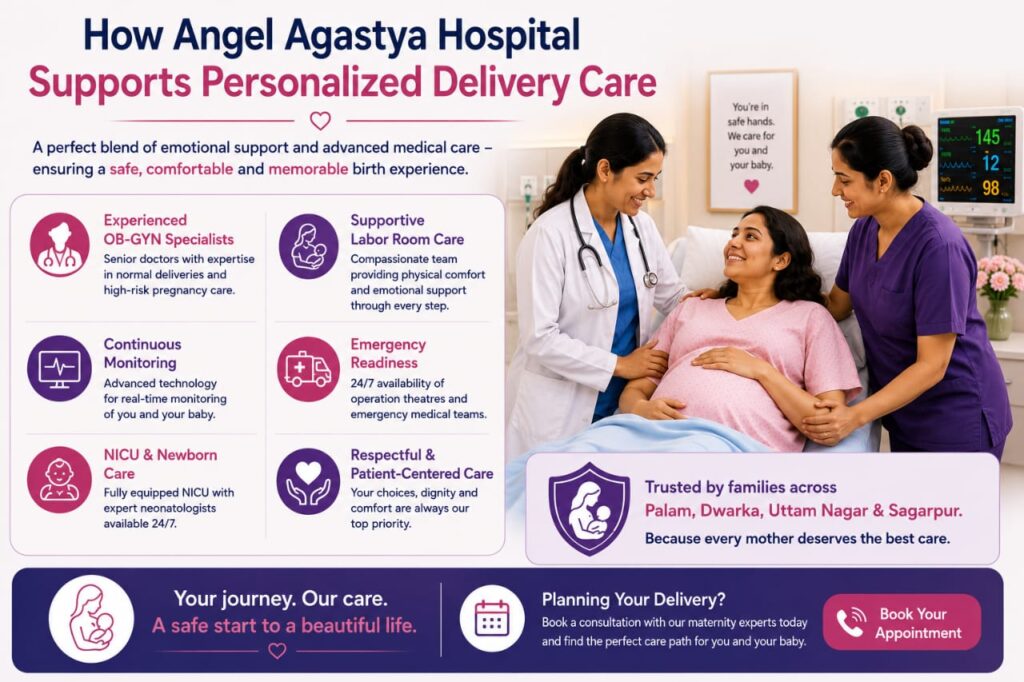
Angel Agastya Hospital provides an advanced maternity framework where emotional support and clinical emergency infrastructure work in perfect harmony.
At Angel Agastya Hospital, we believe that every mother deserves a birth experience that feels both emotionally fulfilling and medically secure. Families from Palam, Dwarka, Uttam Nagar, and Sagarpur trust our dedicated wing because we remove the gap between comfort and safety. We don’t force you to compromise; we wrap you in a comprehensive safety net.
Our specialized maternity ecosystem provides:
Experienced OB-GYN Specialists: Senior doctors who specialize in guiding normal deliveries and managing high-risk complexities with quiet expertise.
Supportive Labor Room Care: A team of compassionate professionals trained to offer physical comfort and continuous emotional encouragement.
Continuous Monitoring: High-precision telemetry systems that keep a constant watch on your baby’s heartbeat.
Emergency Readiness: Dedicated surgical suites and a fully equipped Neonatal Intensive Care Unit (NICU) available 24/7.
Our goal is to ensure that you feel completely informed, deeply supported, and entirely confident as you take the final steps of your pregnancy journey.
Summary
Midwives and OB-GYNs are complementary partners in maternity care, where one provides continuous physical and emotional support and the other brings advanced medical and surgical readiness.
The absolute safest and most fulfilling birth experience comes from combining both philosophies within a well-equipped hospital environment. Your decision should always be based on your individual health condition, your personal comfort levels, and your delivery goals.
By understanding these differences, you can replace late-pregnancy anxiety with total clarity, knowing that you have selected a supportive, system-backed path for a healthy and positive childbirth experience.
FAQs
1. Is a midwife better than an OB-GYN for normal delivery?
Not necessarily. Both provide exceptional support for a normal delivery, and the best choice depends entirely on your specific pregnancy health risks and your personal comfort preferences.
2. Can a midwife handle delivery complications?
Midwives excel at guiding natural labor progression, but they are not trained for surgical or advanced medical interventions; if a complication arises, an OB-GYN must take over immediately.
3. Is OB-GYN care necessary for low-risk pregnancy?
While a low-risk pregnancy can be beautifully guided by a midwife, having medical supervision and hospital infrastructure available is still critical to protect against sudden, unpredictable labor changes.
4. Can both providers work together during childbirth?
Yes, many progressive hospitals utilize a collaborative maternity care model where midwives handle comfort and emotional support while OB-GYNs manage clinical safety.
5. What matters most for a safe delivery experience?
A highly experienced medical team, continuous fetal monitoring, 24/7 emergency readiness, an on-site NICU, and respectful, patient-centered communication are the absolute most important factors. 👉 If you are currently planning your delivery and want to experience the perfect balance of emotional comfort, clinical safety, and expert maternity care, schedule a consultation with our pregnancy specialists today to discover the ideal path for your family’s journey.